How a B2B founder can launch a content machine on LinkedIn

Guide: How a B2B founder can launch a content machine on LinkedIn

Throughout 2024, I have been refining collaborative technology for creating LinkedIn content with clients. We have produced a lot of content, including more than 250 video posts.

As a result, we have obtained a smooth process consisting of four stages utilizing AI at some points:

1) from content strategy to post topics
2) from data to content strategy
3) from topics to video interviews with the founder
4) from recorded interviews to creating posts

The complete guide is below.

Part 1: from content strategy to post topics

The first cornerstone is that posts that hit the target and bring clients are created based on a content strategy.

Below is an example of CONTENT STRATEGY developed for one of our clients (shortened version).

✅ (70%) Subject matter expertise (your expertise, insights, industry, specific skills/tools)

Advantages of using open source in the enterprise
Why Drupal may be the next CMS platform for your business
Drupal as an ecosystem for AI-powered business innovations
Consider mobile app as a part of a company’s headless data architecture
Learning management system based on Drupal: Features
Drupal development: architecture, versions, PHP, libraries
Approaches to ensure Drupal website security
Drupal website SEO: guidelines, tips, modules
Share tips and strategies for optimizing Drupal site performance
Boosting Conversions with a Drupal design and UI/UX
Implementing A/B testing for Drupal landing pages: tools and techniques
Challenges with large websites: education, finance, healthcare, FMCG, etc
Maintaining robust security measures to protect sensitive data on Drupal
Seamlessly integrating Drupal with existing systems and third-party services
Running a fleet of websites on the Drupal platform
Adapting Drupal websites to different languages and regional regulations
Migration to Drupal: the process, security, data and feature transfer, service interruptions, etc
Drupal community and certifications, contribution to core
.
55 pillar themes
.
.
✅ (15%) Personal stories (experience, career, built-in-public, backstage, lifestyle)

How our company addresses industry-specific challenges
Our heroes and our culture
Our failures and we overcome them
Our remarkable achievements
Founder’s story, career, experience
.
15 pillar themes
.
.
✅ (15%) Offer and conversion content (solutions, use cases, differentiation in competition, case studies, etc.)

Showcase successful projects and client testimonials.
Highlight ROI and benefits clients experienced through our services
Special offers with a limited term
.
15 pillar themes

Every month, we feed this strategy to ChatGPT (Claude, Gemini) and ask it to get us 20 LinkedIn post topic ideas for the coming month.

We don’t get ultimate topics! We get IDEAS!

Working with this stuff manually, we create specific topics for our monthly CONTENT PLAN.

👌 This approach helps us ensure that all posts are aligned with the client’s content strategy.

PS. I opened just one part of the process. How did we develop the Content Strategy itself? This is a question for the next Part.

Part 2: from data to content strategy

In the previous part, I discussed how we get topics for daily LinkedIn posts using content strategy. Now, I will explain how we develop the content strategy itself.

We get a content strategy DRAFT using an AI prompt constructed based on the business positioning, ICP (ideal customer profile), and ICP’s “jobs to be done.”

Below is an example of a PROMPT developed for one of our clients.

The ABCD brand offers ALL-IN-ONE Business Administrative Services for businesses interested in registering a company in Singapore and managing it remotely.

ABCD’s services:
- Company registration
- Provision of a local director, address, and secretary
- Obtaining licenses
- Registration of intellectual property
- Accounting and taxes
- Business Consulting
- Staff recruitment

Who are ABCD’s clients, and what are their primary reasons to register a company in Singapore?

1) E-Commerce and Digital Businesses
- Taxes (!)
- Local talents
- Proximity to APAC markets
- The way for Founder’s relocation

2) Startups
- Taxes
- Local talents
- Access to investments, grants, and funds (!)
- The way for Founder’s relocation

3) Fintech Companies
- Taxes
- Comfortable Regulation Policy (!)

4) Investment Holding Companies
- Stable Political and Legal System (!)
- Taxes

ABCD is planning to use LinkedIn content marketing to attract clients.
Please help ABCD with a content strategy on LinkedIn.
Give me 30-50 content pillar themes ABCD should constantly discuss on LinkedIn to educate potential clients and build trust.

We don’t get the ultimate strategy—we get a DRAFT with pillar themes in the subject matter.

Working with this stuff manually, we highlight and expand our business’s 3-5 crown themes, add 10-15 personal and 10-15 conversion themes, and get a well-balanced content strategy (see Part 1).

Part 3: from topics to video interviews with the founder

After the first two stages of working on the founder’s content, we have 12-20 post topics for the upcoming month. We need to fill these topics with content and use the video interview method.

Simply put, we need to find out what our founder thinks about these topics. Therefore, we organized and recorded a video interview with the founder.

The process looks like this:

✅ We conduct a preliminary discussion session with the hero on topics. We note 3-5 key points for each topic that will serve as a micro-script for responses during the recording.

✅ For recording the interview, we use the podcast recording module on the Descript (TM) platform. This tool has a local caching function, which ensures high recording quality for all participants and independence from connection quality during the session.

✅ The interview recording session consists of a sequence of questions from the host and responses from the hero.

How should our hero respond on camera to questions related to the topics? Below are the basic templates.

TEMPLATE 1 - PROBLEM / SOLUTION
There is a problem
Intensify the problem
Provide a solution

TEMPLATE 2 - STORY / TAKEOUT
Intriguing headline
Short story
Conclusion/summary/call-to-action

TEMPLATE 3 - TASK / GUIDE
How to solve [task]?
Step 1
Step 2
….
Step N

TEMPLATE 4 - CASE STUDY
The problem was...
The solution was...
The result

TEMPLATE 5 - MYTH / DEBUNKING
There is a myth
Arguments against the myth
Call-to-action

***

Note-1
Please shorten the response text (6-10 sentences)

Note-2
Please shorten the sentences (4-8 words)

This stage provided raw video footage of our hero’s responses on all topics for the upcoming month.

This method allows us to create authentic founder content. Furthermore, after recording the interview, our process no longer requires the hero’s participation.

Part 4: from recorded interviews to creating posts

Earlier, we discussed three stages of content creation. The last stage (content processing) remains, where we need to turn the raw recording of the video interview with the founder into a package of posts ready for publication on LinkedIn.
What do we do at this stage?

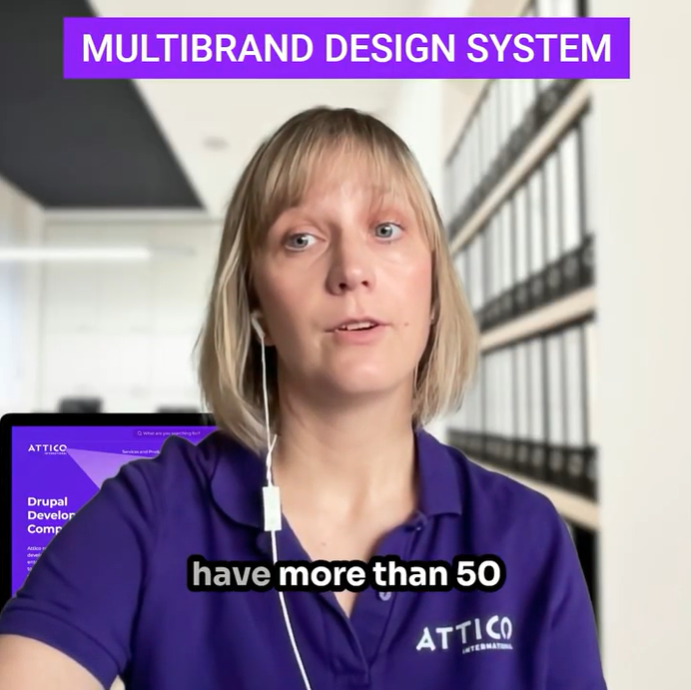
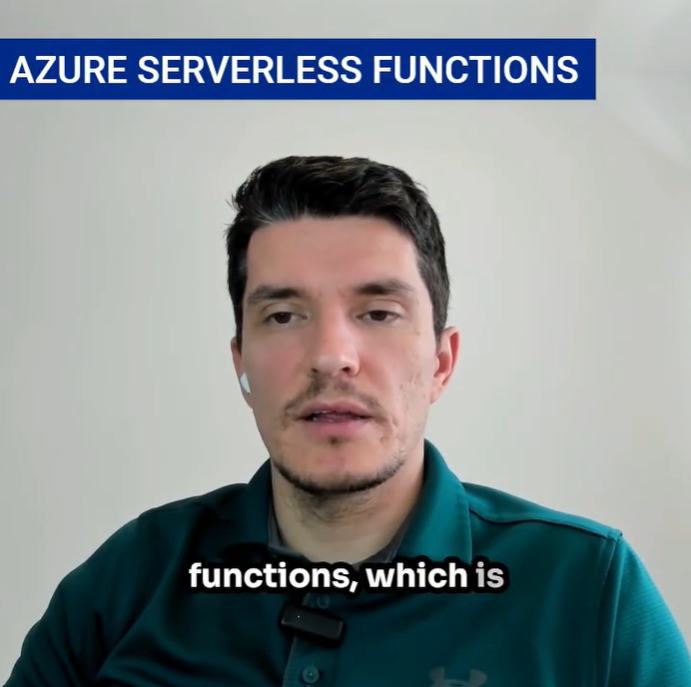
✅ The video recording is processed using the Descript (TM) platform, which provided us with the original recording. We will work only with the video recording of our hero’s responses and the transcript text automatically generated by the platform.

✅ First, we must decide which responses to use in a video post format and which to convert into a PDF carousel or a text post. We use the VIDEO+TEXT format for 70% or more of our posts, as this format is currently the most effective for developing our hero’s brand.

✅ Preliminary AI processing of the video may include features such as improving sound quality, removing pauses and filler words, changing the background, and speeding up the video.

✅ Next, we cut the video into separate scenes (posts). Processing each scene includes manual video editing, correcting transcription errors, changing the aspect ratio, adding subtitles, titles, and other formatting.

✅ The transcript of each scene is used to create the text part of the post, duplicating the video content. The depth of text editing may vary, but we strive to maintain the author’s original tone of voice.

✅ Links to the completed posts are placed in the Content Calendar, which our client will use for publishing.
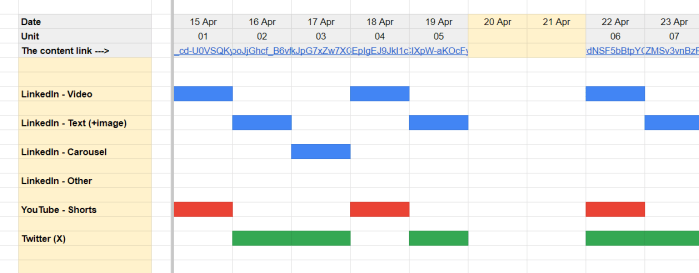
I have outlined the technology used for the joint production of video-first LinkedIn content for the client.

Using this guide, a B2B founder can organize content creation independently, with the marketing department, or with the help of our team. Our service packages are available here.
Two opposing trends with software development services for US enterprises

Two opposing trends with software development services for US enterprises

1) The market is saturated with both domestic and offshore providers, making it difficult to get contracts.

2) There is a significant shortage of senior-level developers that overheat hourly rates.

Which trend is more robust now?

It would seem that if you have a very strong team, you should have no problem getting a contract. On the other hand, if you have a good contract, you can buy resources from many competitors. One of these should work.

This intriguing paradox highlights the complexity of the current software development services market.

Let’s analyze both trends:

Trend 1: Market Saturation

– Many providers compete for contracts

– Includes both domestic and offshore options

– Makes it challenging to secure new business

Trend 2: Senior Developer Shortage

– Scarcity of experienced, high-level talent

– Driving up rates for senior developers

– Potentially affecting project costs and timelines

To determine which trend is more robust currently, we need to consider several factors:

1. Supply and demand dynamics:

   – While there are many service providers, the demand for software development remains high, especially for specialized skills.

   – The shortage of senior developers is a more specific and acute issue within the broader market.

2. Impact on pricing:

   – Market saturation typically leads to price competition.

   – The senior developer shortage is driving up rates at the high end of the market.

3. Quality considerations:

   – Not all service providers in the saturated market offer equal quality.

   – Senior developers are valued for their expertise and ability to handle complex projects.

4. Long-term implications:

   – Market saturation might lead to consolidation or specialization among providers.

   – The senior developer shortage will likely persist due to the time required to gain extensive experience.

5. Geographic factors:

   – Market saturation varies by region and specialization.

   – The senior developer shortage is more consistent across different markets.

Given these considerations, the senior developer shortage (Trend 2) is currently the more robust trend. Here’s why:

1. It’s a more persistent issue that can’t be quickly resolved.

2. It directly impacts project quality, timelines, and costs.

3. It affects both service providers and in-house development teams.

4. It’s driving innovation in talent development, retention, and alternative staffing models.

5. It’s forcing companies to reconsider their approach to software development and team structure.

While significant, market saturation is mitigated by the continued high demand for software development services and the ability of quality providers to differentiate themselves.

On the other hand, the senior developer shortage is a fundamental challenge affecting the entire industry and will likely shape strategic decisions for years to come.

(❗) This analysis suggests that while companies must navigate a competitive market, the scarcity of top-tier talent is currently the more pressing and influential factor in the software development services landscape for US enterprises.

Statistics: Senior-level developers shortage

I’d be happy to provide some statistics about the shortage of senior software developers in the US market. The statistics are based on different reports, which has a cutoff date of April 2024.

Here are some relevant statistics:

1. Job openings vs. qualified candidates:

According to a report by the US Bureau of Labor Statistics, the job outlook for software developers is projected to grow 22% from 2020 to 2030, much faster than the average for all occupations. This translates to about 189,200 openings for software developers each year over the decade.

2. Time-to-hire:

A survey by Dice.com found that the average time-to-hire for senior software developers increased from 45 days in 2019 to 61 days in 2023, indicating growing difficulty in finding suitable candidates.

3. Salary trends:

The Robert Half Technology Salary Guide reported that salaries for senior software developers increased by 15-20% between 2020 and 2024, outpacing many other tech roles and reflecting the high demand for these professionals.

4. Experience gap:

A study by Stack Overflow in 2023 found that only 25% of developers in the US have more than 10 years of professional coding experience, highlighting the scarcity of truly senior talent.

5. Retirement wave:

The Computing Technology Industry Association (CompTIA) estimated that about 20% of senior developers in the US were expected to retire between 2020 and 2025, further exacerbating the shortage.

6. Skills mismatch:

A 2023 survey by TechRepublic found that 67% of IT leaders reported a significant gap between the skills they need and the skills available in the job market, particularly for senior-level positions.

7. Regional disparities:

According to data from the US Bureau of Labor Statistics, the concentration of software developers varies significantly by state. For example, California, Washington, and New York have the highest employment levels but also face the most severe shortages of senior talent.

8. Education pipeline:

The National Center for Education Statistics reported that while computer science graduates increased by 50% between 2015 and 2023, it still wasn’t sufficient to meet the growing demand for senior developers, given the years of experience required.

These statistics show a significant shortage of senior software developers in the US market, driven by rapid industry growth, an aging workforce, and the time required to develop senior-level expertise. However, please verify these figures with the most recent reports, as the technology job market can change rapidly.

Statistics: Software development services demand

Certainly. The demand for software development services has been growing across various industries in the US. Here are some statistics that illustrate this trend:

1. Healthcare:

The healthcare IT market size was valued at $74.2 billion in 2023 and is expected to grow at a CAGR of 13.2% from 2024 to 2030. This growth is driven by the increasing adoption of electronic health records (EHR) systems and telemedicine platforms.

2. Finance and Banking:

The US fintech market was valued at $112.5 billion in 2023 and is projected to reach $324.3 billion by 2028, growing at a CAGR of 23.6%. This indicates a significant demand for software development in mobile banking, blockchain, and AI-driven financial services.

3. Retail and E-commerce:

The US e-commerce software market was valued at $6.2 billion in 2023 and is expected to grow at a CAGR of 16.3% from 2024 to 2030, driven by the increasing shift towards online shopping and the need for advanced e-commerce platforms.

4. Manufacturing:

The industrial IoT market size in the US was $77.3 billion in 2023 and is projected to reach $150.3 billion by 2028, growing at a CAGR of 14.2%. This growth indicates an increasing demand for software solutions in smart manufacturing and Industry 4.0 initiatives.

5. Education:

The US EdTech market was valued at $43.5 billion in 2023 and is expected to grow at a CAGR of 17.2% from 2024 to 2030, driven by the increasing adoption of online learning platforms and educational software.

6. Automotive:

The automotive software market in the US was valued at $18.5 billion in 2023 and is projected to reach $43.5 billion by 2028, growing at a CAGR of 18.7%. This growth is fueled by the development of connected cars, autonomous vehicles, and in-vehicle infotainment systems.

7. Energy and Utilities:

The US smart grid software market was valued at $7.2 billion in 2023 and is expected to grow at a CAGR of 20.3% from 2024 to 2030, indicating an increasing demand for software solutions in energy management and smart grid technologies.

8. Real Estate:

The PropTech (Property Technology) market in the US was valued at $18.2 billion in 2023 and is projected to reach $86.5 billion by 2032, growing at a CAGR of 16.8%. This growth signifies an increasing demand for software solutions in property management, virtual tours, and smart building technologies.

9. Agriculture:

The US precision agriculture market was valued at $3.8 billion in 2023 and is expected to grow at a CAGR of 13.5% from 2024 to 2030, indicating a rising demand for software solutions in farm management, crop monitoring, and IoT-based agricultural systems.

10. Media and Entertainment:

The US media and entertainment software market was valued at $22.7 billion in 2023 and is projected to reach $47.2 billion by 2028, growing at a CAGR of 15.8%. The increasing demand for streaming services, gaming, and digital content creation tools drives this growth.

These statistics demonstrate the widespread and growing demand for software development services across various industries in the US. Each sector is experiencing digital transformation, increasing the need for specialized software solutions.

Conclusion

The demand for development services is very uneven across industries and specializations. For many tasks, demand exceeds supply. Find your niche to reduce competition.

The personnel shortage is more large-scale and long-term. Talent acquisition and retention are critical functions for a software development company. Master the art of remote talent management.

Daily 60 min of Boring-To-Boring to succeed on LinkedIn

Daily 60 min of “Boring-To-Boring” to succeed on LinkedIn

An essential part of many B2B leaders’ business activity is consistent work on LinkedIn to build their brand and attract high-value clients.

Publishing quality content is only half the job. The other half is about engaging an audience and developing a network of professional contacts. This article is devoted to this part.

Below, you can get acquainted with the daily work system used by our clients (Founders of B2B technology companies) on LinkedIn. This system allowed many of them to build a flow of incoming requests from potential clients within three to four months.

Day Program on LinkedIn (60 minutes)

It is recommended to perform the Program 4-5 times a week (on weekdays). The minimum frequency is three days a week.

Recommended session time is 10.00 GMT-5.

1. Thought leaders

✔ Go to LinkedIn notifications.

✔ Read the latest posts of your 10-15 Thought Leaders (bells on).

✔ Do like their posts.

✔ Put 3-5 meaningful comments under leaders' posts.

✔ If possible, continue the discussion in the comments.

✔ In addition to leaders, you should also support friends and colleagues with likes and comments.

<< Do it in advance. Select 10-15 Thought leaders in the niche and enable BELL in their profile. >>

2. Post

✔ Publish your current post.

✔ Reply to all comments received within the first hour.

3. Target lists

✔ Go to LinkedIn Sales Navigator and open your filter with the target audience.

✔ Select the next 20 people.

✔ For everyone - look at the latest post, like it, and try to comment.

✔ For each - send a connection request (without a message).

<< Do it in advance. Create a target audience filter in LinkedIn Sales Navigator. >>

4. Other

✔ Check past missed comments under your posts and respond to them.

✔ Check incoming connection requests and accept requests from worthy people.

5. Direct messages

It is recommended to send DMs only if there is a “signal of intent” on the part of the target person or his company. When a signal appears, you can send a personalized message offering your product/services and a mandatory mention of the signal.

<< Do it in advance. Formulate a list of intention signals. >>

As you may have noticed, we must prepare three components before running our system. We’ll discuss this prep work using one of our clients as an example. This company automates business processes in Microsoft Cloud for medium-sized companies in the USA.

Favorite thought leaders

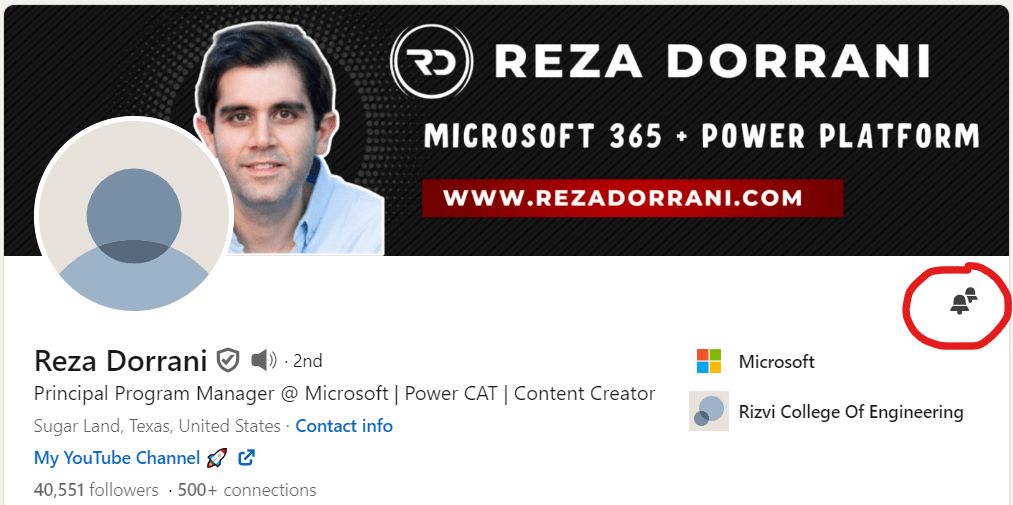
LinkedIn has an excellent option for turning on a bell on a person’s profile to be notified of all their posts (see screenshot).

You should choose 10-15 profiles that interest your audience and you personally. These could be vendor employees, ambassadors of a specific technology, or authoritative users. Note that relevance is more important than the number of followers when choosing a leader.

Next, you read and comment on your favorite experts often. They will answer you. Over time, you develop relationships, communicate in direct messages, and possibly do podcasts and live.

What does this give?

1) You learn how to create content and grow an audience from the leader.

2) If you do everything right, their audience partially becomes yours.

3) Sometimes, a successful comment under an influencer’s post can be more impactful than a dozen of your posts.

Target list in Sales Navigator

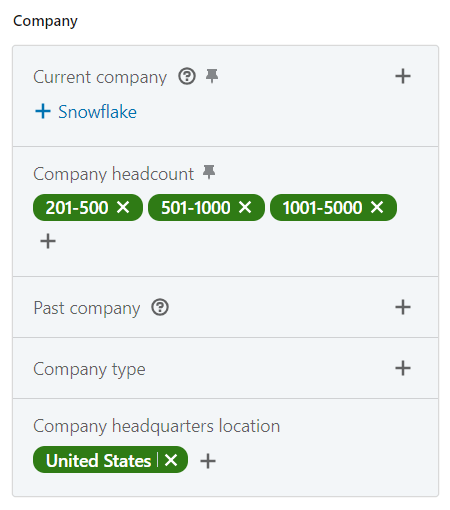
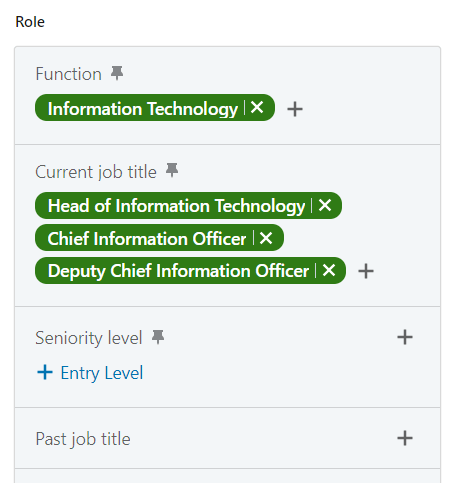
A filter for finding the target audience in our example with a business process automation company might look like this.

Intent signals

Signals in our example with a business process automation company might look like this:

  • The CIO mentioned in the post some technologies we work with
  • The company is hiring a CIO or IT manager
  • CIO took up a position in the new company
  • Other

Searching for signals of intent is a function that can and should be automated. There are professionals in the market who use advanced tools to solve this task. You can outsource the work with signals.

Thanks

We hope this staff will help you strengthen your authority on LinkedIn and achieve your business goals.

And remember the basic principles:

  • Be consistent
  • Share and educate
  • Add in discussions
  • Support others
  • Build relationships

B2B advertising with a limited budget

B2B advertising with a limited budget

How to do effective B2B advertising if your budget has been cut in half?

Answer. Don’t show ads to untargeted people.

How do you think we could do this?

Build lists and advertise only for targeted lists.

Why couldn’t this have been done before?

It could be.

(!) But now, in the face of cut budgets and more compressed demand, it makes sense to stop all other advertising.

How do we advertise only for targeted lists?

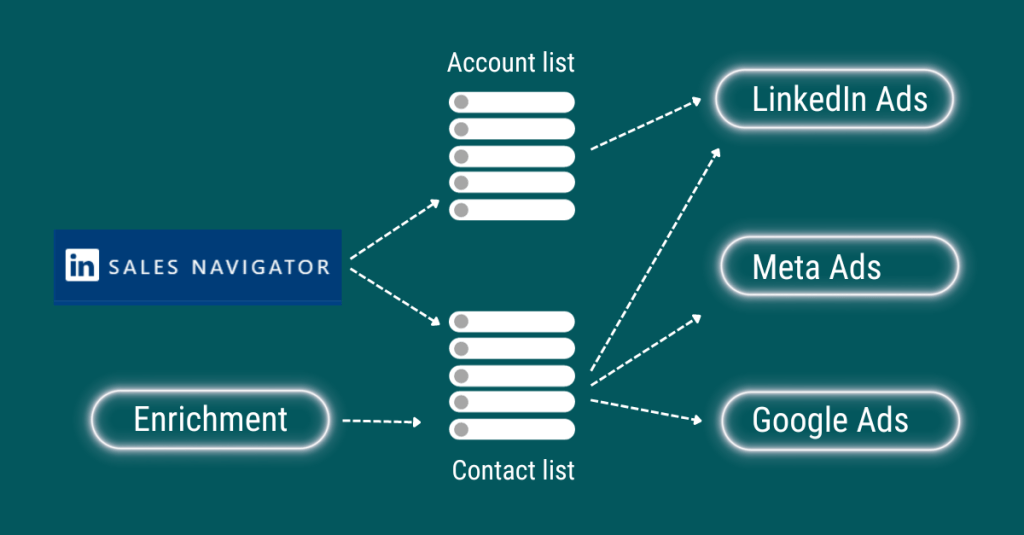
We’ll need LinkedIn Sales Navigator, LinkedIn Ads, Google Ads, Meta Ads, and some third-party services.

Here is the scheme:

1) Use LinkedIn Sales Navigator filters to find target companies. Clean the received list manually. Download this account list using third-party services. Now we have List 1.

2) Use LinkedIn Sales Navigator filters to find decision-makers in List 1 companies. Download this contact list using third-party services. Now we have List 2.

3) Enrich email addresses in List 2 using third-party services.

4) Upload Lists 1 and 2 to launch Engagement / Traffic campaigns in LinkedIn Ads.

5) Upload List 2 to launch Engagement / Traffic campaigns in Meta Ads.

6) Upload List 2 for launching Google Ads campaigns:

  • Google Display campaigns for the list
  • YouTube In-Stream campaigns for the list
  • Google Search RLSA campaigns for the list

7) Add retargeting campaigns for website visitors across all platforms.

(!) If you have completed steps 1 and 2 well, your advertising will be shown only to potential clients.

Even LinkedIn Ads with micro budgets can be effective

What do I mean?

Traditionally, we think of advertising as a separate marketing tactic. We are building an advertising funnel. For example, we attract potential customers to a website using Google Search Ads. We then do retargeting for website visitors using LinkedIn/Meta Ads.

Such a funnel usually requires a significant budget. And it is suitable for scaling a business.

What if our B2B is a young brand looking for its first customers?

Should we abandon advertising tools for now?

No. This is wrong.

(!) We can effectively use advertising tools not as a separate tactic but as an addition to our inbound social media marketing program.

For example, we actively develop our network on LinkedIn, create demand, and receive inbound leads. How can we improve and speed up this work?

We can use LinkedIn Ads to solve specific tasks:

1) Guaranteed delivery of our best posts to prospects from our target list.

2) Growing followers on our LinkedIn Company Page.

3) Attracting potential clients (from the target list) to our online/offline event.

These can be ad campaigns with a limited period and a $300-$500 budget.

And this can skyrocket our inbound marketing results.

Ask us how to build a paid acquisition system for your business.

ABM Make easier B2B sales to your key prospects

ABM: Make easier B2B sales to your key prospects

How to stop attracting junk leads to your B2B website?

1) You sell a powerful ERP system for manufacturing companies, but a small business submits the form on the website.

2) You are selling a facial recognition system for banks, but search advertising brings in students preparing an article.

3) You sell an AI system for large retailers, but a novice programmer comes to the call.

The situations are different, but the reason is the same:

Companies sell expensive and complex products to a limited number of clients but still use traditional online marketing methods.

This is a mistake.

These businesses’ marketing programs should be addressed to prospect lists only or mainly.

ACCOUNT. BASED. MARKETING.

PORTRAIT-BASED vs. ACCOUNT-BASED marketing for B2B

Suppose your company develops mobile applications for retail and e-commerce.

Focus on a broad market of merchants or work only with large retail companies?

500 BIG RETAILERS vs. 20,000 D2C ECOM

Please take a look at your practice.

☝ Where do 80% of the profits come from?

BIG RETAILERS? –> Account-Based Marketing Program

D2C ECOM? –> ICP-Based Marketing Funnel

These are different marketing approaches.

❌ You can do both, but then you need two budgets.

✅ It is better to focus on what gives 80% of the result.

You can make a conscious choice before investing in marketing.

Three Whales of Account-based Marketing

1) LinkedIn unique data and capabilities integrated with CRM.

We can “reveal” the structure of our potential clients’ companies and follow the insights. We can find employees who influence the purchase decision.

2) High-quality content that is produced regularly.

Minimum – social media posts, case studies, blogs, and product videos.
Maximum – webinars, live events.

3) Spot advertising for company lists and contact lists.

We may advertise on major platforms to ensure we deliver our best content and offers.

No spam. No gray tactics.

What do we get?

1) Only prospects click on our ads.

2) Only prospects book a call with salespersons.

3) Only prospects are invited to our events.

4) Our content is delivered in a targeted manner to our prospects.

5) We can personalize messages for our prospects.

👌 As a result, we repeatedly reduce CAC (customer acquisition cost).

Work with the list of companies within the ABM program

Usually, it is not difficult to build a target list.

1) Do we need banks? There are websites of the central banks.
2) Do we need retailers? There are industry reports and ratings.
3) Do we need startups? There is CrunchBase.

Suppose our business offers an ERP system for manufacturing companies. We have created a list of potential clients.

Can we start the ABM program?

Stop.

We are dealing with a mature market.

Presumably, many of the companies on your list are already using advanced ERP solutions from your competitors.

We should spend resources on exploration and information gathering.

If the company already uses one of the modern ERP solutions, excluding it from the list or transferring it to an inactive state makes sense.

Let’s say we cut our list by 30%.

☝ This means that we have reduced our marketing costs by 30% without any loss in performance.

This is the first step towards personalizing our account-based marketing.

ABM: Build relationships with the best 500-2500 prospects

ABM strategy step by step:

1) Build a target list of companies in CRM.

2) Use LinkedIn to collect a targeted list of persons in companies.

3) Establish connections with the target persons on LinkedIn.

4) Post on LinkedIn constantly.

5) Launch ads for the target lists on LinkedIn and Meta. Promote your content. Invite people to events.

6) Monitor interest and activity from contacts.

7) Use Social Selling tactics to work with active contacts from the list.

8) Create opportunities for salespersons.

Why do we need advertising if we do Account-based marketing?

Decisions about B2B purchases with a high ACV are made for a long time.

We must be “on the radar” of our prospects for a long time and regularly.

Suppose we have 1,000 companies and 5,000 personas in our target lists.

How do we ensure that content is delivered to this limited audience?

SOLUTION – LINKEDIN ORGANIC
We can connect with a person on LinkedIn, and he/she will see our posts.

RESTRICTIONS.
We will get consent to connect in about 40% of cases. And even after that, not all of our contacts will see our posts.

We reach 700-1500 personas.

SOLUTION – EMAILS

RESTRICTIONS.
We need permission from him/her to deliver an email to a person. These people have already registered for our webinars or signed up for newsletters. There are not very many of them.

We reach 200-500 personas.

SOLUTION – ADVERTISING
We may show ads on 2-3 platforms to people from our targeted lists.

RESTRICTIONS.
Our budget only.

We reach 2000-4000 personas.

If we are talking about Account-based marketing for a target list of 500 or more companies, advertising is one of the critical tools.

Does your B2B company need ABM?

ABM should not be seen as something new to replace traditional B2B marketing based on client portraits.

In one case, the ABM approach may be the best strategy; in another, it may lead to unjustified restrictions.

The position of my team is not biased in this matter.

We offer both approaches for B2B companies:

1) Implementing an ABM program intensified by multi-channel advertising for targeted lists.

2) Launching an advertising funnel using search, retargeting, and targeted ads for client portraits.

Choosing an approach for a specific business is sometimes not easy.

But it makes sense to consider the ABM approach for businesses with an ACV (Average Contract Value) above $30,000.

Next, you need to consider the many parameters of a specific business.

Decisive factors:

  • To whom are we going to sell?
  • How many are there in the target market?
  • How many of them can bring us 80% of the profit?
  • Is there a generated demand?
  • The cost of advertising in the target market
  • Competition with the leaders in the category
  • Does our ACV pay for personalization costs?
  • How can we collect the necessary information about prospects?
  • etc

The right strategy –> The lower client acquisition costs.

Contact us to discuss an ABM program intensified by multi-channel Ads.

Is the B2B Advertising Funnel Working or Not

Is the B2B Advertising Funnel Working or Not?

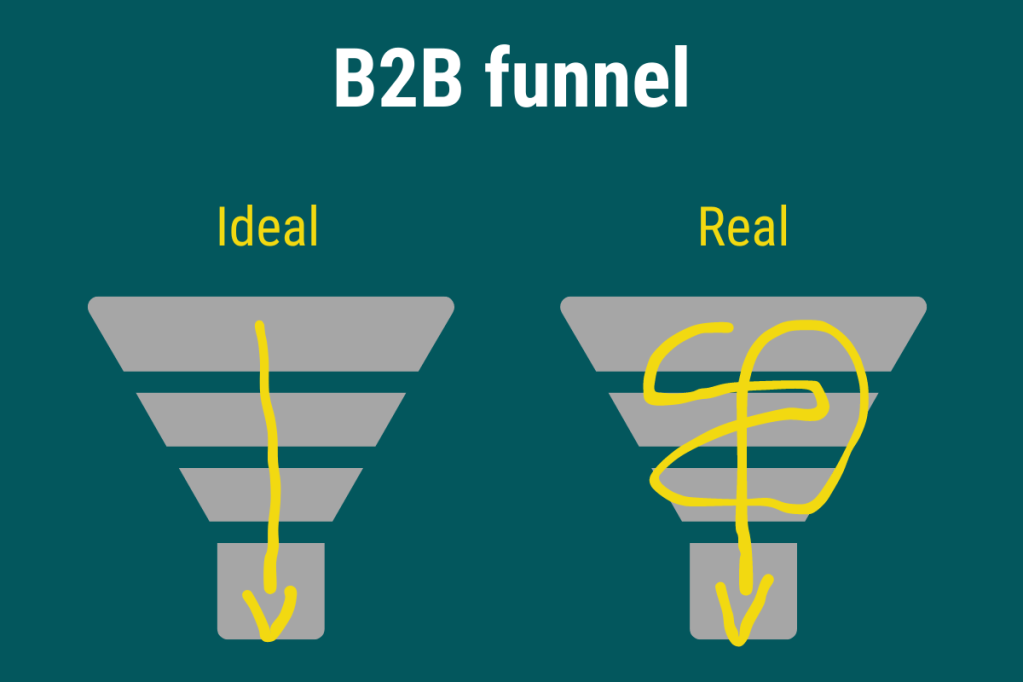
First, let’s figure out if there is a funnel.

The audience awareness funnel is always there. This is a fundamental concept that applies to people, not technology.

TOF (top-of-funnel)
The person has not yet thought about the problem or is unaware of your solution.
(50-100% target audience)

MOF (middle-of-funnel)
The person knows about your product and competitors’ products.
(0-50% target audience)

BOF (bottom-of-funnel)
The person compares products or makes a purchase decision.
(1-5% of the target audience)

What is the problem with acquiring clients from the funnel?

Today, technology has allowed your client to consume a lot of information on the fly. The client can learn almost everything about your product on social platforms and from other community users.

B2B marketers have almost completely lost the ability to track a client’s progress through the awareness funnel.

As a result, the emergence of clients’ buying intent looks unpredictable.

One client can get all the information they need in ChatGPT five minutes before purchase.

The other person will decide based on information received a year ago from an expert at LinkedIn.

How to work with this “dark funnel”?

As mentioned above, we do not know where today’s leads are.

And we don’t know where tomorrow’s leads are.

We must work with the entire target audience.

We need marketing activities across the funnel!

And not only in advertising.

Blog Articles —> TOF, MOF, BOF.

Social media posts —> TOF, MOF, BOF.

Advertising —> TOF, MOF, BOF.

(❗) B2B brand marketing and advertising must continuously deliver the right information to all funnel levels.

How to build a funnel in B2B advertising?

1) BOF/MOF – Google Search Ads to capture demand, drive quality traffic to your website, and generate leads.
(30-70% of the advertising budget)

2) BOF/MOF – Remarketing for active website visitors on Google, YouTube, Facebook, and LinkedIn. Content delivery. Delivering offers and getting leads.
(20-40% of the advertising budget)

3) MOF/TOF – Active search for potential clients on YouTube, Facebook, and LinkedIn. Content delivery.
(10-50% of the advertising budget)

Is this structure suitable for any B2B?

The advertising strategy itself is versatile.

The implementation of the strategy is individual for a particular business:

– coverage of semantics in the search
– content type and remarketing creatives
– platforms/tools for finding potential clients
– advertising funnel width
– the balance of campaign budgets inside the funnel
– other

Such an advertising funnel can be built even with a small budget.

Do you know how this can work for your B2B?

Ask us how to build a paid acquisition system for your business.

Multi-platform Remarketing Strategy for a B2B SaaS

Multi-platform Remarketing Strategy for a B2B SaaS

Remarketing aims to continue communication with active site visitors to bring prospective clients to a conversion action.

This strategy includes remarketing campaigns on the following platforms – Google Ads & YouTube, Facebook Ads, and Linkedin Ads.

The following tasks we discuss below:

  1. Collect audiences for remarketing ads.
  1. Prepare audiences for exclusion from remarketing ads.
  1. Messages for remarketing ads.
  1. Remarketing campaigns.

Collect audiences for remarketing ads

Active Site Visitors =

Those who visited the “Pricing” page

OR

Those who started “Book A Demo” but didn’t submit the form

OR

Those who clicked on the “Download eBook” button

OR

Those whose session time was more than the average for the website.

Google Ads & YouTube

First, we must create a Google Ads account, Google Analytics 4 account, and a YouTube channel. 

Second, we must install GA4 Tag on the site and mark up events (custom Instructions).

Then we can create remarketing audiences:

  • GA4 Active Site Visitors 30 days
  • GA4 Active Site Visitors 180 days

Facebook Ads

First, we must create FB Page, IG profile, FB Business Manager, FB Domain, FB Ads Account, and FB Pixel.

Second, we must install FB Pixel on the site and mark up events (custom Instructions).

Then we can create remarketing audiences:

  • FB Active Site Visitors 30 days
  • FB Active Site Visitors 180 days

Linkedin Ads

First, we must create LI Business Page and LI Ads Account.

Second, we must install Linkedin Insight Tag on the site and mark up events (custom Instructions).

Then we can create remarketing audiences:

  • LI Active Site Visitors 30 days,
  • LI Active Site Visitors 180 days.

Prepare audiences for Exclusion from remarketing ads

We should use Core Audience from CRM:

  • Those who have a paid subscription,
  • And those who have subscribed in the past,
  • And those who are close to purchasing from the sales funnel.

This list should have at least 1000 members (matched by advertising systems).

Now we should integrate this audience with our advertising accounts if we have this feature in our CRM (for example, Hubspot).

If we experience difficulties with the online integration of this audience with advertising accounts, we will have to download/upload this list manually every 1-2-4 weeks.

Messages for remarketing ads

CTA messages (for short audiences)

  • Image + Text Copy with “Schedule a demo” CTA,
  • Image + Text Copy with “Buy subscription” CTA (with a promo code),
  • 20-40 seconds promo videos with CTA,
  • 20-40 seconds Case/UGC videos,
  • Links to case studies.

Educational/nurturing messages (for long audiences)

  • Links to case studies,
  • 20-40 seconds Case/UGC videos,
  • 30-300 seconds product features videos (not tutorials),
  • Links to the best blog posts,
  • The new version releases/updates.

Remarketing campaigns

Google Ads

1) Tr display – ActiveSiteVisitors 30d

  • High frequency
  • CTA messages

2) Tr display – ActiveSiteVisitors 180d

  • Low frequency
  • Educational messages

Google Ads / YouTube

3) Tr video – ActiveSiteVisitors 30d

  • High frequency
  • CTA messages

4) Tr video – ActiveSiteVisitors 180d

  • Low frequency
  • Educational messages

Facebook Ads

1) Tr rem – ActiveSiteVisitors 30d

  • High frequency
  • CTA messages

2) Tr rem – ActiveSiteVisitors 180d

  • Low frequency
  • Educational messages

Linkedin Ads

1) Tr rem – ActiveSiteVisitors 30d

  • High frequency
  • CTA messages

2) Tr rem – ActiveSiteVisitors 180d

  • Low frequency
  • Educational messages

This is a basic remarketing scheme that makes sense to start with, especially if you have little traffic on the site.

As traffic grows, segmenting visitors and making remarketing more personalized will be possible.

PS. This strategy doesn’t cover the work with prospects who have already given us their contacts (email, phone). If they are still at the top of the sales funnel, we suggest communicating with them using email marketing tools.

Ask us how to build a paid acquisition system for your business.

3 pillars to build marketing for a new B2B

3 pillars to build marketing for a new B2B

A young startup with a B2B software product approached my partner and me to develop a marketing strategy.

The guys said they didn’t know what marketing channels would work for their product, so they needed a roadmap.

At the consultation, we told them it was not initially worth developing a detailed strategy.

The client today has nothing but a product landing page.

Therefore, they must lay the foundation:

  • Set up content production
  • Create a system for distributing content on social networks
  • Run competitive demand capture in Google search

This should, in any case, be done before they start podcasting or using other advanced tools.

Marketing strategy template

We gave them the most straightforward marketing strategy Template.

BASIC level activities:

1) Site blog, SEO

Next step – Newsletters by email.

Goals – demand creation, demand capture.

2) Google Search Ads, Multi-channel Remarketing

Goals – demand capture.

Next step – Display/Youtube Ads for prospects.

Goals – to fill a demand funnel.

3) SMM on Linkedin/Twitter/Facebook

Next step – Paid Social for prospects and for content promotion.

Goals – demand creation

We believe that this Template is UNIFIED for a starting B2B.

ADVANCED level activities (for later):

  • Podcast in a niche
  • Youtube expert channel
  • educational courses
  • offline events
  • own offline events
  • account-based marketing/sales (ABM)
  • brand awareness advertising
  • partnerships

How to enrich a B2B company’s marketing with paid channels?

B2B marketing strategy is based on content. Therefore, it is important to use advertising channels to capture existing demand and effectively distribute content.

Below is the structure of our framework. The effectiveness of each activity is time-tested.

1) Google Search Ads to attract high-quality site traffic.

2) Remarketing Ads on Google, YouTube, and Social Media for active website visitors (for short and long audiences). Here is an example of the remarketing strategy.

3) Youtube Video Ads to fill a demand capture funnel. Combine targeted in-stream ads with ads for conversions.

4) Paid Social to reach target audiences with your best content (to scale demand creation).

This program does not require a large advertising budget.

Paid marketing for your B2B will be effective if…

…you accept the facts below.

1) B2B marketing = content marketing. Before using paid channels, you must create a content machine.

2) B2B marketing takes time. It will take us at least two months to evaluate the return on ads (even if it’s search ads to capture demand).

3) The company’s website must be ready for conversions. The site should contain – precise service/product positioning, client benefits, product/service features, pricing, case studies, and expert content.

4) We must build a combined tracking system (see below) for our acquisition funnel. We will use attribution software as well as first-hand customer data.

5 essential steps to measure our B2B marketing

We face significant challenges in measuring the effectiveness of marketing channels and campaigns.

– B2B marketing takes time. An effective campaign can take a long time to generate leads.

– Many interactions of prospective clients with our brand cannot be measured in principle (content consuming, community discussions, private communications, etc.).

– Attribution software capabilities and quality suffer from new privacy standards.

Does this mean we should measure less?

NO.

We must measure more.

1) Implement basic multi-channel tracking and analytics.

Use GA4 on your website. Implement parallel server-side conversion tracking using Google Measurement Protocol. Additional server-side tracking will help reduce privacy-related data loss.

2) Use advanced end-to-end tracking.

Track end-to-end chains “Traffic source –> Website –> CRM” using features of your marketing platform like Hubspot.

3) Use Ad system pixels and tags.

Implement Facebook Pixel / LinkedIn Insight Tag on your website. Set up parallel server-side conversion tracking (FB Conversion API).

4) Measure more micro-conversion events.

Mark up more events for each tracking system – playbook downloaded, the lead form started, pricing page visited, video tutorials viewed, newsletters subscription, etc.

5) Use self-reported attribution.

Add the question “How did you hear about us?” to lead forms on your website.

The biggest mistake you can make is to trust sources with distorted or truncated data.

This leads to wrong decisions and loss of money.

Spare no effort to build a solid data system to drive your marketing.

Ask us how to build a paid acquisition system for your business.

5 reasons you need a branded campaign in Google Search Ads

5 reasons you need a branded campaign in Google Search Ads

CLIENT: “We don’t need an ad campaign for the keyword MYBRAND. We’re first in Google’s organic search. Don’t waste my money on ads for these search terms.”

I have been working with Google Ads for six years, and I have to discuss this with almost every client.

Answers.

1) About the first position in organic search results

If, for any query, you are the first in organic results in Google search, your site will be shown in the fourth position. The first three positions show paid ads.

2) About wasted money

If your brand name is not advertised by any of the competitors, then the cost of a click on your ad will be equal to 1 cent.

If one of the competitors is advertising under your brand’s name, you should beat his bid.

3) Monitor demand and brand awareness

Example. There have been fewer orders on the site for the last three days. What’s the matter? Are we having problems with the site? Competitive activity? It could be a fluctuation in demand. Look at traffic changes in a branded search campaign.

We can measure traffic growth in a branded campaign over long periods of time. This will allow us to track the increase in our brand awareness.

4) Sophisticated branded searches

“MYBRAND cashmere coat”

This is a search query for our brand name.

This is our client.

BUT.

There will be stiff advertising competition for this query because of the phrase “cashmere coat”.

If we do not win the auction in advertising, then competitors will take our client away.

5) Google Ads algorithms

Your MYBRAND brand sells the coolest hoodies on the market.

You have a competitor.

He ran ads for the keyword BUY COOL HOODIE in the BROAD match.

The client types in Google search – BUY MYBRAND.

Competitor ads will be shown for this search term.

Always start your Google ads with a branded search campaign.

What bidding strategy should we use for branded search campaigns in Google Ads?

We have these working alternatives:

1) Target CPA

2) Target Impression Share

3) Manual CPC

At a high enough bid, any of the above strategies will generally allow a branded campaign to achieve its goals. But there are some nuances.

EXAMPLE №1

We sell niche software under the brand MYPROG.

There are a lot of non-productive branded searches on Google.

“MYPROG alternatives”
“MYPROG download free”
“MYPROG key activation”
“MYPROG crack”
etc.

We need optimization for conversions here.

The “Target CPC” bidding strategy will be the best choice in this situation.

EXAMPLE №2

We have a leading mass-market shoe brand.

We want a branded campaign to work for conversions, site traffic, and brand awareness.

Here we should use the “Target Impression Share” or “Manual CPC” strategy.

Which of these two?

Our practice for both strategies results in impression share above 95%. Testing required.

Ask Albert how to build a paid acquisition system for your business.

How to get View_Rate = 69% in YouTube Ads

How to get View_Rate = 69% in YouTube Ads?

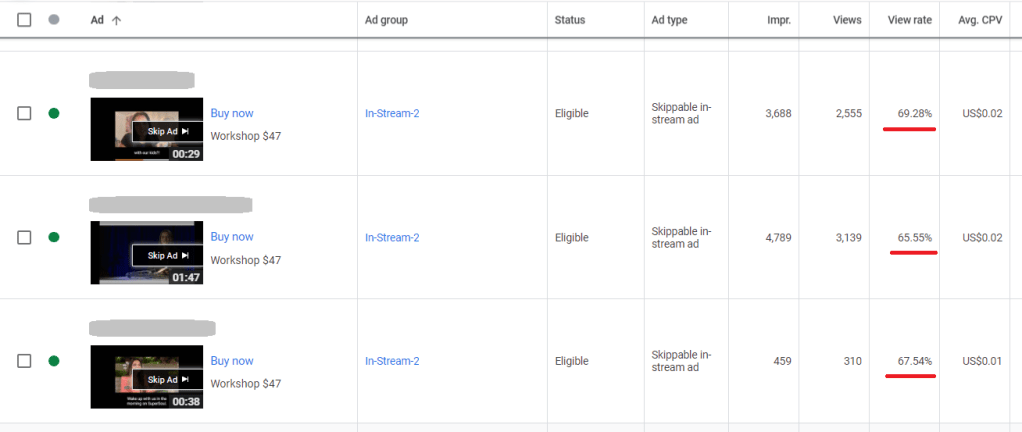
Answer #1 = intersection of targeting conditions.

Audience segments” (custom segments with keywords, in-market segments, interests, and events)

AND

Demographics” (age, gender, parenting status, etc.)

AND

Placements” (manually selected YouTube channels where to display ads)

The complication of the targeting conditions in this example allowed us to increase the View_Rate by TWO times.

A free promo video enhancement tool

Not everyone knows about this tool; even fewer people use it.

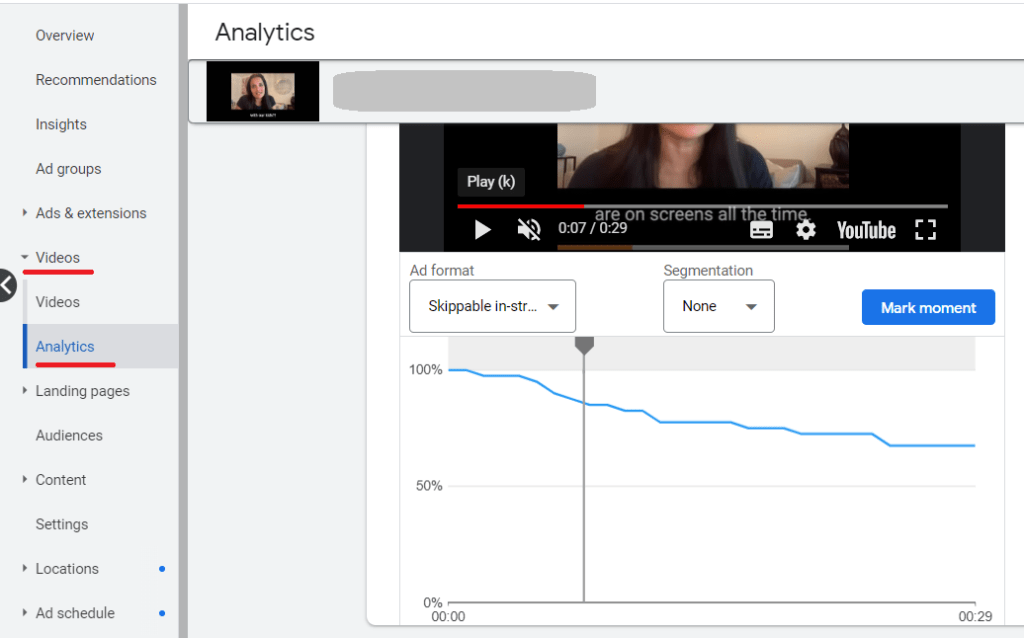
It is inside Google Ads. See screenshot.

This chart is simply unique.

It shows how people interrupted watching as the video progressed from the beginning to the end.

Sometimes, you can see distinct downward jumps at the point where the audience gets bored.

Sometimes, you can see a long horizontal plateau where the story holds viewers.

You can use this information to improve individual pieces of your ad.

You can draw conclusions that will make your next ad more effective.

I haven’t come across a more helpful tool for working with video ads.

Use it!

An easy way to use famous YouTube bloggers to promote your product

You are sure that the followers of a prominent blogger will love your product, but cooperation with this blogger is expensive.

There is an alternative way to solve this task.

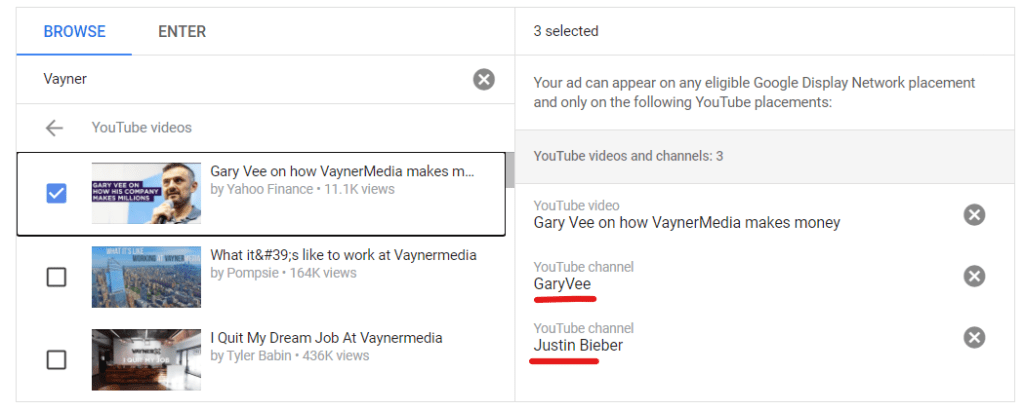
1) Create an In-stream video campaign in Google Ads (YouTube) to promote your video.

2) Next, you choose where your video will be shown in the campaign settings.

3) You can choose a specific YouTube channel or video.

This route may not be as effective as a live story by a famous blogger about your product.

However, you can reach your desired audience.

And you can do this as many times as you like.

This is quickly achievable.

Why YouTube Ads?

1) Video is the most effective advertising format.

2) On average, 40% of In-Stream video impressions result in a view.

3) Powerful targeting tools by intent, keywords, placements, etc.

4) Giant reach opportunities within YouTube.

5) Relatively low cost of advertising.

Today, it is an excellent tool for discussing a product, explaining a solution, and making a brand visible.

Ask Albert how to build a paid acquisition system for your business.